Quick Answer:
According to Noticias Súper, Siemens holds that industrial artificial intelligence has stopped being a promise and is now the new standard on which manufacturing is being redefined. Eduardo Gorchs, CEO of Siemens South America (excluding Brazil), says Industrial AI scales knowledge and speeds up implementation, as long as the technology empowers people rather than replacing them.
Key Takeaways:
- Industrial AI is no longer experimental: according to Noticias Súper, Siemens describes industrial artificial intelligence as the new operational standard for manufacturing, not a technology still in the testing phase.
- Digital twins connect data to decisions: Noticias Súper reports that Siemens is pushing the use of digital twins to turn production data into concrete operational results.
- Industrial Copilot simplifies engineering: per Noticias Súper, this Siemens generative AI tool helps reduce the complexity of technical tasks within industrial operations.
- Eduardo Gorchs links AI to talent: Noticias Súper quotes the CEO of Siemens South America (excluding Brazil) saying Industrial AI closes the talent gap because it scales knowledge.
- The advantage is empowering people, not replacing them: according to Noticias Súper, Siemens' position is that true competitive advantage emerges when technology empowers people.
A report published by Noticias Súper on July 10, 2026, describes a fundamental shift in how Latin America's manufacturing industry is using artificial intelligence: no longer as an isolated experiment in a pilot plant, but as the standard around which day-to-day operations are being reorganized. According to the outlet, Siemens is the central voice in this analysis, focused on how industrial AI turns production data into concrete operational decisions.
For any business owner, whether in Houston, Cypress, or an industrial hub in Latin America, the message behind this report does not depend on plant size or sector: the question is no longer whether artificial intelligence is coming to the operation, but how quickly the company can move from testing it to using it every day.
From promise to operational standard
According to Noticias Súper, Siemens' position is direct: artificial intelligence is no longer a promise, it is the new standard on which industry is being redefined. It is an important distinction. For several years, the conversation around industrial AI centered on pilots, proofs of concept, and isolated use cases. The report describes a different moment, one in which the technology stops being an experimental initiative and starts becoming part of how a manufacturing line is planned, run, and maintained.
That phase shift —from promise to standard— is also why many mid-sized companies in the region feel pressure to modernize their processes: it is no longer about "whether it's worth trying AI," but about the fact that an operation that does not integrate it starts falling a step behind the one that does.
Digital twins and Industrial Copilot: from theory to operation
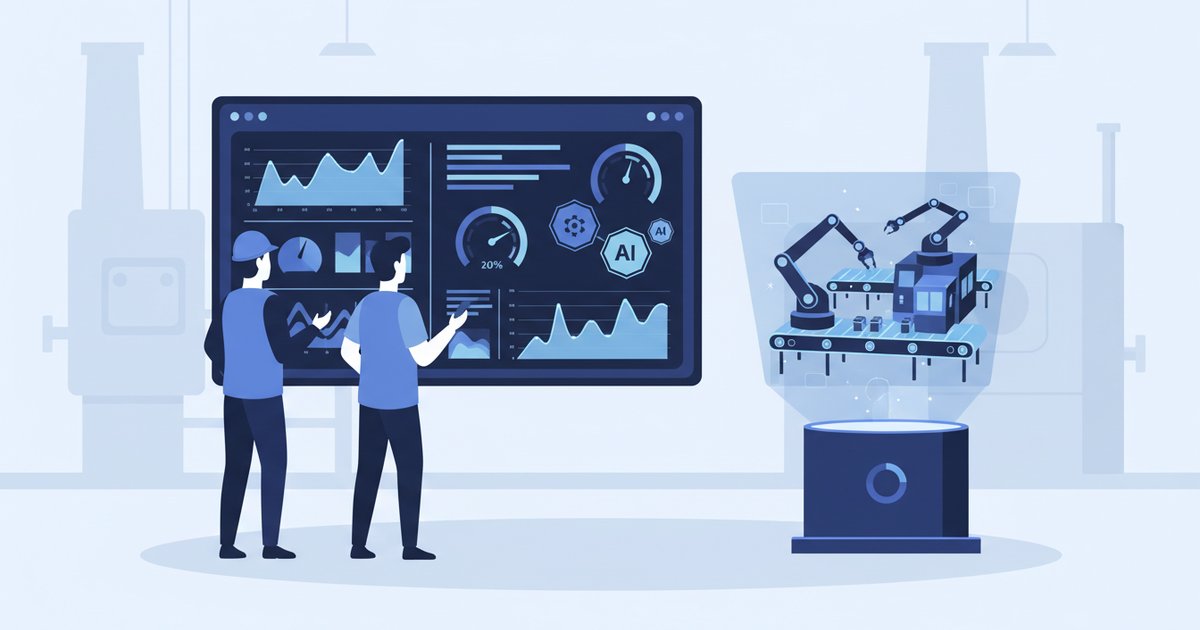
Noticias Súper identifies two concrete pieces of this transition. The first is digital twins —virtual representations of a production line or a piece of equipment that make it possible to simulate, anticipate, and adjust the operation before a real problem occurs. The second is Industrial Copilot, a Siemens generative AI tool designed to simplify engineering tasks that traditionally required highly trained specialists.
The report's central quote: "Industrial AI is no longer a promise, it is the new standard on which industry is being redefined" —Siemens' position as cited by Noticias Súper.
Together, these two pieces point in the same direction as the report's title: more predictive, more efficient production. A digital twin makes it possible to anticipate a failure before it happens; Industrial Copilot makes that advanced technical knowledge accessible to more people within the same plant, not just to the most experienced specialist on the team.
The talent gap and Eduardo Gorchs' role
One of the most relevant findings in the Noticias Súper report is the connection it draws between industrial artificial intelligence and the shortage of technical talent. Eduardo Gorchs, CEO of Siemens South America (excluding Brazil), is quoted saying that Industrial AI allows that gap to be closed, since it scales knowledge. It is a different way of framing the problem: it is not just about hiring more specialized engineers, but about using technology so that available knowledge reaches further and goes to more people within the operation.
That idea —scaling knowledge instead of only adding headcount— is particularly relevant for mid-sized industrial operations that compete for the same scarce technical talent as large multinationals, but without the same budget to attract it.
The report also makes a second point equally central: technology does not replace people, it empowers them. According to Noticias Súper, Siemens' position is that true competitive advantage emerges when technology empowers people —not when it tries to substitute them. It is an important distinction at a moment when many conversations about industrial automation generate more anxiety than clarity about the future role of human teams.
What this means for your business
The Noticias Súper report describes a transition within industrial manufacturing, but the same underlying logic —moving from experimenting with AI to AI being the standard of the operation— applies just as directly to how a business gets found by its customers today. Just as a plant that does not adopt predictive maintenance falls a step behind one that does, a business whose digital presence is not structured for AI to understand it becomes invisible next to the competitor that got there first.
When a potential customer asks ChatGPT, Perplexity, or Google AI Overviews who offers a product or service in their area, the answer depends on whether your business has the structured data, content, and trust signals those AI systems need to cite you. It is the same principle Siemens describes for manufacturing, applied to the channel where your next customer is already asking the question.
This is exactly the work of our AI Search Optimization (AEO) service: identifying what your digital presence is missing for AI to find you and recommend you, before it does that for your competitor instead. The starting point is the MerchandisePROS free audit, which evaluates your business in under 60 seconds and shows you exactly which AI signals you're missing.
Frequently Asked Questions
What does Siemens say about industrial artificial intelligence in Latin America?
According to Noticias Súper, Siemens holds that industrial AI is no longer a promise, but the new standard on which manufacturing industry, including Latin America, is being redefined.
What is Industrial Copilot?
As Noticias Súper reports, Industrial Copilot is a Siemens generative AI tool that helps simplify complex engineering tasks within industrial operations.
Who is Eduardo Gorchs and what did he say about the talent gap in industry?
Eduardo Gorchs is the CEO of Siemens South America (excluding Brazil). According to Noticias Súper, Gorchs stated that Industrial AI allows that gap to be closed, since it scales knowledge.
Is industrial AI meant to replace manufacturing workers?
No. Noticias Súper reports that, per Siemens, the true competitive advantage emerges when technology empowers people, not when it replaces them.
"The same logic Siemens describes for manufacturing applies to any business: the advantage isn't having the technology, it's being the first in your category to use it every single day."
- Diego Medina F, Founder of MerchandisePROS