Quick Answer:
Mexico is becoming a magnet for AI infrastructure investment. According to DataCenterDynamics, Terranova, backed by Actis, launched its first campus in Querétaro as part of a roughly $1.5 billion plan for Brazil, Mexico, and Chile over three years. According to Introl, the regional market is projected to reach $14.30 billion by 2030.
Key Takeaways:
- Terranova's investment: according to DataCenterDynamics, the Actis-backed platform launched its first Mexican data center in Querétaro as part of a roughly $1.5 billion plan for campuses in Brazil, Mexico, and Chile over three years.
- Market size: according to Introl, Latin America's AI infrastructure is projected to reach $14.30 billion by 2030 at a 12.21% compound annual growth rate.
- Regional leadership: according to Introl, Brazil accounts for over 41% of regional investments while Mexico's market grows at 15% annually.
- Nearshoring push: according to Introl, around $150 billion in infrastructure is reaching Mexico as supply chains move closer to the United States.
- New capacity: according to Introl, the region will add 1,831MW between 2025 and 2030, with 858MW in Brazil and 431MW in Mexico.
Something profound is shifting on the map of artificial intelligence, and this time the epicenter is not in Silicon Valley. It is in Querétaro. Whether you run a business in Houston, Cypress, Monterrey, Mexico City, or Bogotá, the next wave of AI compute is being built closer to you than you imagine — and that changes the rules for anyone who wants to compete in the digital economy.
The most recent trigger is a multibillion-dollar bet by an infrastructure-backed data center developer, layered on top of the nearshoring wave that has been redrawing North America's supply chains for years. Together, these two forces are turning Mexico into one of the two anchors of AI infrastructure in Latin America.
What Terranova Is Building in Mexico
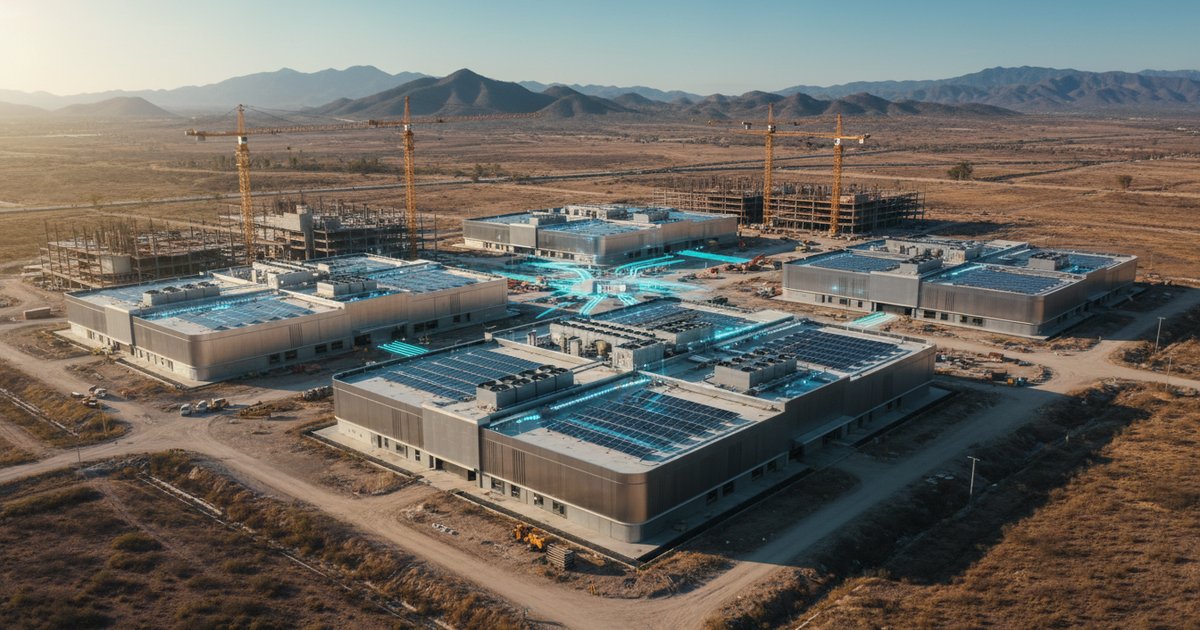
According to DataCenterDynamics, Terranova, the data center platform backed by infrastructure fund Actis, launched its first data center in Mexico, located in the Querétaro region — one of Latin America's most dynamic digital hubs. The facility is designed to meet growing demand for AI capacity, cloud services, and mission-critical applications.
As DataCenterDynamics reports, this first facility is part of an investment plan of around $1.5 billion to deploy large campuses across Brazil, Mexico, and Chile over the next three years. The Querétaro site can scale to 20MW of capacity and is expected to become operational during the first quarter of 2026.
Why the speed matters: When an infrastructure operator commits billions of dollars to hyperscale campuses across three countries, it is betting that AI demand in the region is not a passing trend but a sustained growth curve. That conviction is the signal business owners should read.
The Nearshoring Wave Feeding the Demand
The data center expansion is not happening in a vacuum. It rides the nearshoring wave — the phenomenon by which companies relocate their supply chains closer to the United States. According to Introl, around $150 billion in infrastructure is reaching Mexico as companies move production and logistics nearer to the U.S. market and increasingly need local compute to run their artificial intelligence workloads.
That physical relocation of operations has a direct digital consequence. A factory that sets up in the Bajío region, a distribution center opening in northern Mexico, or an e-commerce operation scaling across the region all need to process data, run AI models, and serve applications with low latency. That is only possible when compute is nearby — which is why nearshoring money and data center money advance hand in hand.
Major cloud providers have also bet heavily on Mexican infrastructure. According to Introl, Microsoft committed $1.3 billion to Mexico and $2.7 billion to Brazil in September 2024 — a vote of confidence in regional capacity from one of the world's largest hyperscalers.
Why Querétaro Became Mexico's Hub
It is no accident that Terranova chose Querétaro for its first facility in Mexico. According to Introl, Querétaro is an industrial corridor attracting hyperscale data center development. The combination of land availability, connectivity, and proximity to industrial corridors has made it the country's reference point for this kind of infrastructure.
Meanwhile, Mexico City maintains its own expanding data center market, with around 60MW of capacity, according to Introl. But it is Querétaro that captures the new generation of hyperscale projects designed specifically for AI workloads.
The opportunity for businesses in Mexico and LATAM:
- Closer AI compute means lower latency and better performance from the tools you already use
- Greater local capacity typically translates into more affordable AI services
- Data processed inside the country makes regulatory compliance easier
- AI adoption is accelerating, and with it the number of consumers who ask AI assistants before they buy
Latin America's AI Market by the Numbers
The backdrop supports Terranova's bet. According to Introl, Latin America's AI infrastructure market is projected to reach $14.30 billion by 2030, growing at a 12.21% compound annual growth rate. Brazil accounts for over 41% of regional investments, while Mexico's market grows at 15% annually — one of the fastest paces on the continent.
In terms of physical capacity, Introl estimates the region will add 1,831MW of data center capacity between 2025 and 2030, with Brazil contributing 858MW and Mexico 431MW. These two countries are positioning themselves as the two anchors of Latin America's AI infrastructure.
The commercial context reinforces the urgency. According to Introl, regional e-commerce represents a $200 billion market growing at 25% annually. Each of those online shoppers is a potential customer who increasingly discovers products and services through AI tools, not just traditional search engines.
The Constraints: Power and Cooling
Growth is not without limits. Hyperscale data centers consume enormous amounts of electricity and water for cooling, and those are the bottlenecks operators must solve to sustain the expansion. The pressure pushes the industry toward renewable energy and greater efficiency.
Energy cost is a key competitive variable. According to Introl, Mexico operates with an electricity cost of around $0.06 per kilowatt-hour — a level that makes regional investment attractive relative to other markets. Solving power supply and cooling sustainably will determine how much and how fast AI infrastructure can grow in the country.
What This Means for Your Business
All of this infrastructure has an effect that reaches far beyond data center operators. As AI compute lands in Mexico and across the region, AI tool adoption among consumers accelerates. More and more people are dropping the search box and asking ChatGPT, Perplexity, or Google's AI Overview directly which provider of a service is best in their city.
Here is the concrete problem your business faces: if those AI assistants do not know, do not understand, or do not trust your business, they simply will not name you in their answers. And when the AI recommends a competitor, you lose the customer before they open a single browser tab. The infrastructure being built in Querétaro today guarantees those AI queries will be faster, cheaper, and far more common in Spanish and across LATAM.
That is why the most urgent piece of the puzzle is Answer Engine Optimization, or AEO. Our AI Search Optimization (AEO) service prepares your business to be visible and cited by ChatGPT, Claude, Perplexity, and Google AI Overviews: we implement the correct schema markup, structure your content in answer-first format, align your NAP data across the web, and build the authoritative citations the AI needs to name you with confidence. The deliverable is clear: when a customer asks the AI for your service in your city, the answer is your name.
"AI infrastructure is arriving in Mexico faster than most businesses are preparing for it. The winner will not be whoever has the prettiest website, but whoever the AI decides to name."
Diego Medina F., Founder of MerchandisePROS
The first step is knowing exactly where you stand. Our free audit evaluates the signals that determine whether AI can find, understand, and cite you, and delivers a 0-to-100 score with a prioritized action plan. It takes under 60 seconds to request, and you receive a PDF report straight to your inbox.
Frequently Asked Questions
How much is Terranova investing in data centers across Latin America?
According to DataCenterDynamics, Terranova, the data center platform backed by infrastructure fund Actis, launched its first data center in Mexico in Querétaro as part of an investment plan of around $1.5 billion to deploy large campuses across Brazil, Mexico, and Chile over the next three years.
Why has Querétaro become Mexico's data center hub?
According to Introl, Querétaro is an industrial corridor attracting hyperscale data center development thanks to land availability, connectivity, and proximity to industrial corridors. Terranova located its first Mexican facility there, with capacity to scale to 20MW.
How large is the AI infrastructure market in Latin America?
According to Introl, the regional market is projected to reach $14.30 billion by 2030 with a 12.21% compound annual growth rate. Brazil accounts for over 41% of regional investments, while Mexico's market grows at 15% annually.
How does nearshoring drive data center demand in Mexico?
According to Introl, the nearshoring wave has drawn around $150 billion in infrastructure to Mexico as companies relocate supply chains closer to the United States and increasingly need local compute to run AI workloads.
What do more local data centers mean for a business in Mexico or LATAM?
More local data centers mean faster, cheaper, and more compliant access to AI services. For a business, that translates into lower-latency AI tools and, above all, more consumers asking AI assistants direct questions, which makes being visible and cited in those answers essential.