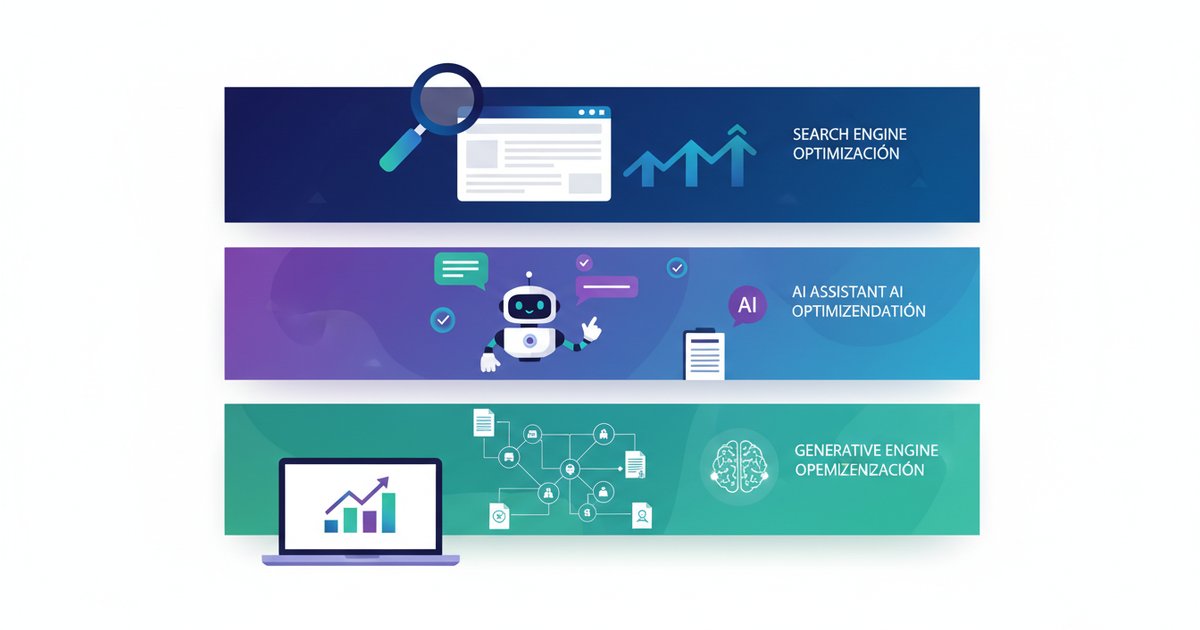
Quick Answer: SEO gets you found on Google, AEO gets you cited by ChatGPT and Perplexity, and GEO positions you as a trusted source in AI-generated summaries. In 2026 a business that only does SEO is invisible to the 30% of buyers already using AI to research before they purchase. You need all three.
Whether you run a business in Cypress, Houston, Monterrey, or Bogotá, you're now competing across three search layers at once, not one. Google still matters. But more customers are asking ChatGPT "what's the best marketing agency near me" before they ever type into Google. If your site is optimized only for traditional search, that conversation with AI is happening without you. The missing layer is called AEO and GEO, and in 2026 it's no longer optional.
The Three Optimization Layers
SEO (Search Engine Optimization) is the foundation everyone knows: keywords, page speed, backlinks, content Google indexes and ranks in its 10 blue links. It's been the only layer that mattered for 25 years.
AEO (Answer Engine Optimization) is different: it optimizes your content so an answer engine — ChatGPT, Perplexity, Copilot — cites you directly when someone asks a question. You're not competing for position #1 on a list; you're competing to be THE source the AI decides to mention. That requires question-and-answer formatted text, verifiable facts, and correctly marked schema.org data.
GEO (Generative Engine Optimization) goes one step further: it focuses on how generative models build full topic summaries, not just short answers. This is where authority signals come in (E-E-A-T: experience, expertise, authority, trust), brand consistency across platforms (same name, phone, address on your site, Google Business Profile, and social), and fresh content with visible update dates.
All three engines read different signals. Google prioritizes domain authority and links. AI engines prioritize clarity, data structure, and whether your brand shows up consistently across multiple sources. Optimizing for only one leaves exact gaps your competitors can walk through.
See the full breakdown of how we handle all three layers on our services page.
Why One Isn't Enough
A dental clinic owner in Katy came to us with one specific problem: his site had ranked #1 on Google for "dentist Katy TX" for two years. Strong SEO, no question. But when we asked ChatGPT "recommend a dentist in Katy, Texas," the answer named two of his competitors and not one word about his clinic.
Why? His site had no `Dentist` or `LocalBusiness` schema.org markup, his Google reviews weren't linked in a way an AI model could verify, and his content didn't answer direct questions ("how much does a dental cleaning cost in Katy?") in a format an AI could confidently extract and cite.
The real outcome: he was winning half the battle and losing the other half without knowing it. Every month, a growing share of his prospective patients asked an AI first, and that AI recommended someone else. Strong SEO doesn't compensate for missing AEO/GEO — they're different layers requiring different work, and a business needs all three running at once to avoid losing ground on any of them.
Key stat: By 2026, more than 30% of U.S. consumer searches are projected to involve a generative AI engine at some point before a purchase decision — a figure climbing month over month according to search-industry reports.
Key Takeaways:
- SEO ranks you on Google; AEO gets ChatGPT and Perplexity to cite you directly; GEO controls how you show up in full generative summaries — three disciplines, not one.
- A business can be #1 on Google and invisible in ChatGPT if its site has no schema.org markup and no question-and-answer formatted content.
- More than 30% of U.S. consumer searches in 2026 are projected to pass through an AI engine before the purchase decision.
- Brand consistency (name, phone, address) across your website, Google Business Profile, and social media is a direct trust signal for AI models.
"If your business only exists for Google, you've already lost half the conversation. AI isn't waiting for you to optimize — it's already recommending your competitor."
Diego Medina F., Founder, MerchandisePROS
Frequently Asked Questions
What's the difference between SEO and AEO?
SEO optimizes for ranking in traditional Google search results. AEO optimizes for an AI answer engine (ChatGPT, Perplexity) to cite you directly as the source of its answer. They require different content structures to succeed.
Does my small business really need GEO?
Yes. GEO isn't just for big brands — it's about data consistency and verifiable authority, both achievable for a local business with correct schema.org markup and a consistent Google Business Profile and social presence.
How long before I see AEO results?
It depends on how often the AI engine crawls your domain (2-6 weeks for newer or lower-authority domains) and whether your content already has question-and-answer structure and complete schema.org markup from the start.
Can I do AEO/GEO without touching my existing SEO?
Yes, they're complementary, not replacements. You add schema.org, structured content, and brand-consistency signals on top of the SEO you already have — nothing gets replaced, you're closing the gap.