Quick Answer:
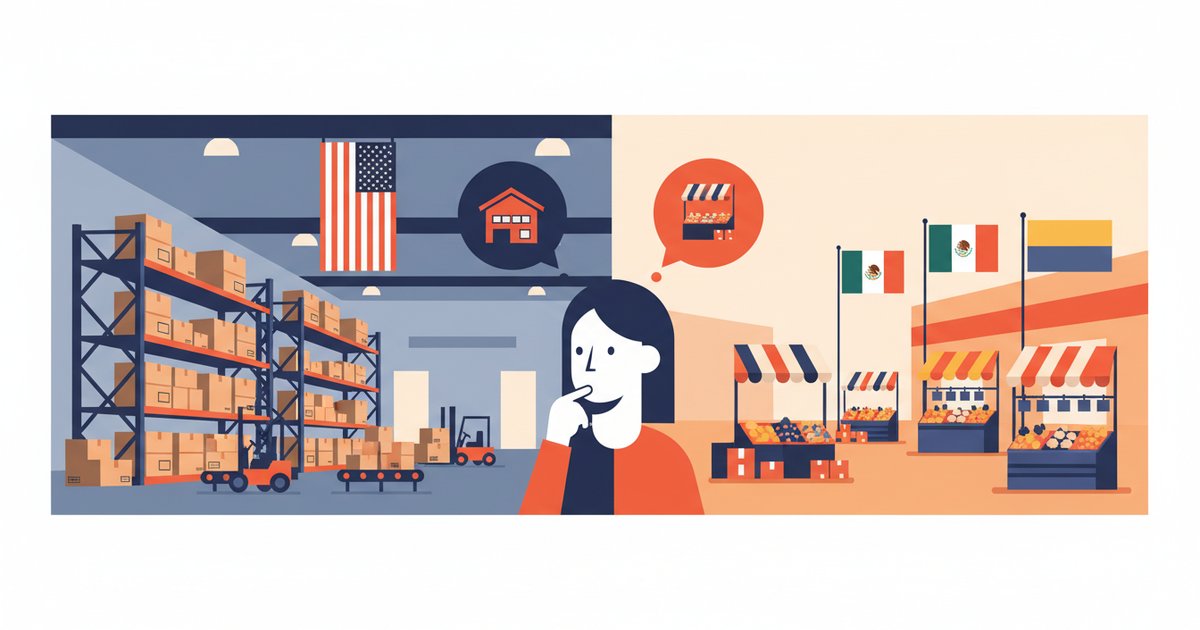
Amazon US makes sense when your product has high USD margin, you can afford FBA, and your target market is the U.S. consumer. MercadoLibre makes sense when you sell in your local market (Mexico, Argentina, Brazil, Chile, Colombia) and your average ticket justifies 12-17 percent commissions plus listing fees. Most successful LATAM sellers do not pick one — they enter local MercadoLibre first to validate product and build capital, then scale to Amazon US.
Key Takeaways:
- Fees compared: Amazon US charges 8-15 percent per sale + $0.99 per unit without a Pro Account; MercadoLibre charges 12-17 percent + a fixed listing fee that varies by country (free for Mexico classic, $7 MXN per unit sold for premium classic).
- Shipping and logistics: Amazon US practically requires FBA (Fulfilled by Amazon) to compete for the Buy Box — meaning you ship inventory to a U.S. warehouse with import costs. MercadoLibre Full offers similar logistics within each country with no cross-border step.
- Taxes and legal entity: Selling on Amazon US as a foreign seller requires W-8BEN, EIN (if you form a U.S. LLC), and handling state sales tax. Local MercadoLibre uses your RFC, CUIT, or NIT and issues invoices under the country's tax rules.
- Ad ecosystem: Amazon Ads (Sponsored Products + Brands) is mature with detailed metrics; MercadoLibre Ads grew fast in 2024-2025 but targeting tools remain a couple of steps behind Amazon. Compensation: MercadoLibre CPC is typically 30-50 percent lower.
- Practical recommendation by country: sellers in Mexico, Argentina, Chile, and Brazil usually earn more entering local MercadoLibre first; sellers in Central America, the Caribbean, and exporters with premium products (handcrafts, specialty coffee, supplements) usually earn more starting on Amazon US.
Why This Decision Defines Your Next 18 Months
Entering a marketplace is not just opening an account. It is a decision that defines what kind of product you buy, how you package it, how you handle refunds, which SKUs you expand, and what capital you tie up in inventory. Switching from Amazon US to MercadoLibre nine months in means renegotiating with suppliers, repackaging inventory, and learning a second interface from zero.
The good news is the decision is not a theoretical dilemma. There are six measurable variables that determine which platform fits your specific situation: your target market, your expected average ticket, your working capital, your cross-border tolerance, the type of product, and your ability to handle accounting in two countries.
Side-by-Side Comparison
Amazon US — Key Features:
- Market size: 300+ million active accounts in the U.S. and Canada.
- Sales commission: 8 to 15 percent depending on category.
- Pro Account: $39.99 monthly (recommended from month one).
- FBA: storage + per-unit fulfillment fees; requires shipping inventory to the U.S.
- Buy Box: dominated by FBA sellers with good reputation; aggressive competition.
- Payouts: every 14 days, in USD to a U.S. bank (or conversion via Payoneer/Wise).
- Restrictions: certain categories (supplements, beauty) require prior approval.
MercadoLibre — Key Features:
- Market size: 150+ million active accounts across 18 LATAM countries.
- Sales commission: 12 to 17 percent by category and plan.
- Listing types: Free (no boost), Classic (boosted), Premium (financing included).
- MercadoLibre Full: equivalent to FBA within each country; no cross-border step.
- Buy Box: friendlier competition; reputation + price + Full shipping are the three factors.
- Payouts: direct to MercadoPago, withdrawals to local bank account.
- Restrictions: vary by country (Argentina restricts imports via AFIP, Mexico allows more).
Country-by-Country Recommendation
This is the part most guides skip. Each LATAM country has its own dynamic. These are the recommendations based on our observations across hundreds of sellers.
Mexico — MercadoLibre first. It is the largest LATAM e-commerce economy and MercadoLibre leads the market. How to sell on Amazon Mexico is a second phase for scaling.
Argentina — MercadoLibre. Practically the only serious option; import restrictions make Amazon US complicated. Details in selling on Amazon from Argentina and neighbors.
Brazil — MercadoLibre Brazil leads but the second spot is contested by Magalu and Shopee. If your target market is in Brazil, MercadoLibre.
Chile — MercadoLibre Chile grew strong and is the local option. If your product exports well (wines, dried fruits, natural cosmetics), Amazon US from Chile has excellent margin.
Colombia — Combine both. MercadoLibre Colombia for the domestic market (textiles, home) and Colombian e-commerce for export.
Peru — MercadoLibre Peru is small but growing. Peruvian e-commerce details; for exportable products (alpaca textiles, coffee), Amazon US works.
Ecuador — Small MercadoLibre market. Ecuador e-commerce guide; for coffee, cacao, and handcrafts, Amazon US is the answer.
Uruguay — MercadoLibre Uruguay is functional but limited. Amazon US from Uruguay is the natural outlet for exportable products.
Venezuela — MercadoLibre Venezuela inactive due to country conditions; context requires export focus. Amazon from Venezuela via Colombia or U.S.
Central America (Costa Rica, Panama, Guatemala) — Central America guide. Small domestic markets; Amazon US is usually the best play.
Bolivia — Minimal MercadoLibre Bolivia. Digital businesses in Bolivia points to Amazon US for premium products.
Dominican Republic — Small domestic market. Dominican creators and e-commerce. Amazon US for export.
The Five Decision Factors
If you have to decide today, these are the five questions that order the choice.
1. What currency does your target market spend in? If your end customer pays in USD, Amazon US makes sense. If they pay in MXN, ARS, BRL, COP, CLP, local MercadoLibre.
2. What is your expected average ticket? Below $15-20 USD, Amazon US is hard — FBA per-unit cost eats the margin. Local MercadoLibre supports lower tickets.
3. Do you have capital to sustain inventory in the U.S. for 60-90 days? FBA requires capital locked in Amazon warehouses. MercadoLibre Full is gentler on cash flow.
4. Does your product survive cross-border shipping? Perishable, fragile, regulated, or lithium-battery products complicate Amazon US. Local MercadoLibre handles them without friction.
5. Can you handle accounting in two countries? Selling on Amazon US as a foreign seller requires W-8BEN, EIN or LLC, state sales tax. If this sounds complicated and you do not have a specialized accountant, local MercadoLibre is the lower-resistance path.
The Most Common Path (and Why It Works)
Of the hundreds of LATAM sellers MerchandisePROS has audited and advised over the years, the most frequent winning pattern is this:
Phase 1 (month 1-9): Local MercadoLibre. You learn the trade in your home market, validate what product turns over, build reputation, working capital, and a logistics team. The learning curve is vertical in your own language with your own customer.
Phase 2 (month 10-18): Selective Amazon US. You take the 2-3 SKUs that rotated best on MercadoLibre and export them. You start FBA at small scale, $5,000-$10,000 USD initial inventory. You aim at premium products with margin.
Phase 3 (month 19+): Diversification. If Amazon US works, you scale. If not, you double down on MercadoLibre with validated SKUs. The mistake is skipping Phase 1 and going straight to FBA — the learning curve is brutal and capital burns fast.
Exceptions to this pattern: exportable premium products (cosmetics, specialty coffee, artisan jewelry, natural supplements) — for those, direct Amazon US can make sense from month one, especially if you come from Colombia, Peru, Chile, or Ecuador where the domestic market is limited.
How MerchandisePROS Supports the Decision
MerchandisePROS audits both platforms. The Amazon listing audit measures 14 signals that determine Amazon ranking. The general e-commerce audit evaluates your website and MercadoLibre store on similar criteria.
The ASIN X-Ray service analyzes a specific Amazon US ASIN to diagnose why it does not rank, does not convert, or has a high return rate. The audit is free; if you want help implementing corrections, we quote per project.
Frequently Asked Questions
Can I sell on Amazon US from Latin America without forming an LLC?
Yes. Amazon US accepts individual sellers with W-8BEN and an international bank account (Payoneer, Wise). Forming an LLC in Delaware or Wyoming simplifies tax handling above $50,000-$80,000 USD annual revenue, but it is not a legal requirement to start.
How much capital do I need to start on each platform?
Local MercadoLibre: $500-$2,000 USD equivalent for initial inventory and premium listings. Amazon US with FBA: $5,000-$10,000 USD minimum (inventory + shipping to U.S. + initial FBA fees). Without FBA on Amazon US, the math rarely works against established sellers.
What about MercadoLibre Brazil — is it worth it?
Yes, for sellers in Brazil or those with a local partner. MercadoLibre Brazil competes hard with Shopee and Magalu, but its penetration is still leading. For sellers outside Brazil, customs regulations make it complicated to enter without physical presence.
Is FBA mandatory on Amazon US?
Not technically, but practically yes. 85+ percent of Amazon US sales happen on listings that use FBA. Competing against FBA without FBA requires very high margin or a specific niche (handmade, artisan supplements). For most SKUs, FBA is the only competitive path.
How much does MercadoLibre actually charge?
Varies by country and listing type. In Mexico: 12-15 percent commission on free Classic (no boost), 15-17 percent on Premium (with financing). In Argentina the structure is similar with additional fees based on amount. Always review each country's fee calculator before setting prices.
Is it worth being on both platforms at the same time?
After local MercadoLibre generates consistent $5,000-$10,000 USD monthly, yes. Before that point, splitting attention between platforms usually worsens results on both. Practical rule: dominate one before adding the second.
"Most Latino sellers who fail at Amazon US do not fail because of the product. They fail by skipping the learning that local MercadoLibre teaches you for free: rotation, returns, ticket, reputation."
Diego Medina F., Founder of MerchandisePROS